Category: Uncategorized

I recently joined Dan Caruso on The Bear Roars podcast, and our conversation brought one thing into focus: we’re living through a shift that’s not just changing what we build—it’s changing how we learn, lead, and collaborate.
We talked about AI, quantum computing, and robotics, but what we kept coming back to was access. How do we make sure every learner, founder, and educator has the tools—broadband, curiosity, and the freedom to experiment—to participate in this next era? The challenge isn’t the technology itself; it’s building the human systems around it that help people adapt and thrive.
Dan introduced the idea of the “super-professional”—someone who doesn’t just use AI, but grows alongside it. What stood out to me is that the real advantage won’t come from mastering the tools themselves, but from staying endlessly curious and open to learning. That mindset of give first—sharing what you learn as you go—feels more important than ever.
Check out the episode here:
Spotify: https://lnkd.in/gMMqrCzH
Apple: https://lnkd.in/gunRWYEH
YouTube: https://lnkd.in/gBzY_fHR
Amazon Music: https://lnkd.in/gkwEvPaY

On Saturday, May 31st, from 3:30 to 5:00 PM in downtown Denver, I’ll have a public conversation with Phil Weiser about various topics, including technology and innovation in Colorado. We will also talk about what (and how) we’ve learned from each other over the years and how we’ve worked constructively through disagreements, conflicts, and mistakes.
Phil’s blog post Startup Community Leadership discusses many of the things he’s done to positively impact the Colorado startup community. My journey with Phil started in 1999 when he co-founded a new center at CU Boulder: the Silicon Flatirons Center for Law, Technology, and Entrepreneurship. While unfortunately named (I hate the name Silicon X for anything, and over the years, I’ve teased Phil many times about this), this began a collaboration between us that resulted in organizations like Startup Colorado and BEN Colorado. It also resulted in the New Technology Meetup, the Entrepreneurial Law Clinic, the Entrepreneurs Unplugged Series, and CU Boulder’s New Venture Challenge.
If you’ve read my book Startup Communities: Building an Entrepreneurial Ecosystem in Your City, you know about the incredible impact that Phil and Brad Bernthal had on engaging CU Boulder with the Boulder Startup Community, starting around 2007. It meaningfully impacted how I thought about how the culture across a University could be changed around entrepreneurship and engagement with a local startup community. I attribute much of the early leadership here to Phil and Brad, who worked as incredible thought partners early on the new approach to developing startup communities I codified in that book, and it has now had a global impact.
Given the other public conversations Phil and I have had, including one with Jamie Dimon at CU Boulder as part of Entrepreneurs Unplugged, I expect we will cover a wide range of topics. It’s a chance to get to know another side of Phil and better understand how we’ve learned from each other over the past 25 years on technology, entrepreneurship, startup community development, government involvement with technology and innovation, leadership, and mentorship.
Anyone who attends will receive a copy of my newest book, Give First: The Power of Mentorship, which I will happily sign if they wish.

As I often do, I had a long, complicated dream last night. I’ve been fighting off a cold, so let’s call it a fever dream. During the dream, I saw the number 2050 on something.
In 2050, I’ll be 84 – an old man by today’s standards. I was running through a city full of tall buildings. It was the middle of the day, but the streets were relatively empty. Little vehicles flew overhead constantly, but they were background noise.
The buildings were full of people. The first floor of the buildings was an extended indoor park – kind of how I envision Chicago’s Lincoln Park in the summer.
While there were people everywhere, there were no offices. There were no retail stores. If there were restaurants, they were embedded within the indoor parks. Maybe the indoor parks were one giant Starmazon facility.
Block after block. The buildings were different shapes and sizes, but they were all modern high-rises. Some might have been apartment buildings while others were offices, but they were now one gigantic container for people.
I went through a portal at the end of a block. I’m fascinated with farcasters from Hyperion – they regularly show up in my dreams – so I’m sure that’s the reference. Without breaking stride, my run continued on a mountain trail. Other than trees, bugs, dirt, flowers, and whatever animals were hiding nearby, there was only me.
The trail ended at a house that I entered. I went to room and sat down on a couch. The wall lit up with video and I suddenly was talking to my partner Seth about something.
I woke up. I was covered in sweat – a combination of the room being too warm and whatever my body was doing to try to knock out my cold. The thought, “why would anyone go to an office” rolled through my mind.
I dozed but remembered the thought when I woke up.

My dreams were vibrant and bizarre last night. It’s no surprise since I finished two books yesterday – The Bright Hour and The Migration. These followed a three-day binge of The Expanse Season 4, which had echoes of BSG Season 3.
I have a recurring nightmare about accounting. I’m running a business, but I can’t get the monthly financials produced. We are many months behind and my partner (sometimes Dave, sometimes my Dad) keeps coming up with reasons we can’t close the books. I continue to hear “we have cash in the bank so don’t worry.” I wander down the endless hallways of my office trying to find the CFO (sometimes Stephanie, sometimes Amy, sometimes someone I don’t know) but I can never find her (it’s always a woman.) There is no resolution to this dream, just a feeling of fear, emptiness, and impending loss.
Yeah, it’s an anxiety dream about company mortality. And both books were about human mortality.
The Bright Hour is a Nina Riggs memoir of her battle with metastatic breast cancer. It’s the gender bookend to Paul Kalanithi’s book When Breath Becomes Air. Equally magnificent, powerful, beautiful, sad, and humbling, all at the same time. I didn’t want the book to end, as I knew that when it did, I’d have to accept that Nina didn’t survive. I knew that before starting the book, but somehow I was able to suspend disbelief of the inevitable while I still had some pages left to read.
The Migration is Helen Marshall’s first novel and it A+++. It’s also about death, with the backdrop of a mysterious plague-like disease that creates hormonal changes in teenagers. Of course, that’s not really what is happening, but that’s part of the power of the story. There are elements of YA here, with teenage protagonists, but it’s not a YA book.
My 2019 reading has been wide and varied but the infinite pile of books to read has grown higher. I’ve got lots of physical books to read for some reason, so that’s what I’m chewing on now. Kindle when I’m traveling; physical when I’m home. We’ll see how that goes for a while.
Will Someone Please Tell Me Exactly What a Looking Glass Can Do?

A few weeks ago I wrote about the launch of the Looking Glass, a desktop holographic display made for 3D creators. Since then, over a thousand people have purchased a Looking Glass for their desks. I think part of the reason for this attention is that the Looking Glass is filling a much-needed hole in the REPL for Hardware flow alongside additive and subtractive desktop 3D printers and laser cutters. It also helps that the Looking Glass works without a VR or AR headset.
If you have ever used a 3D printer, has Unity, Maya, or Blender on your computer, or isn’t scared by terms like “volumetric video” and “light-field photography”, you should probably have a Looking Glass. For 48 more hours, you can get one of your own for 25% off here.
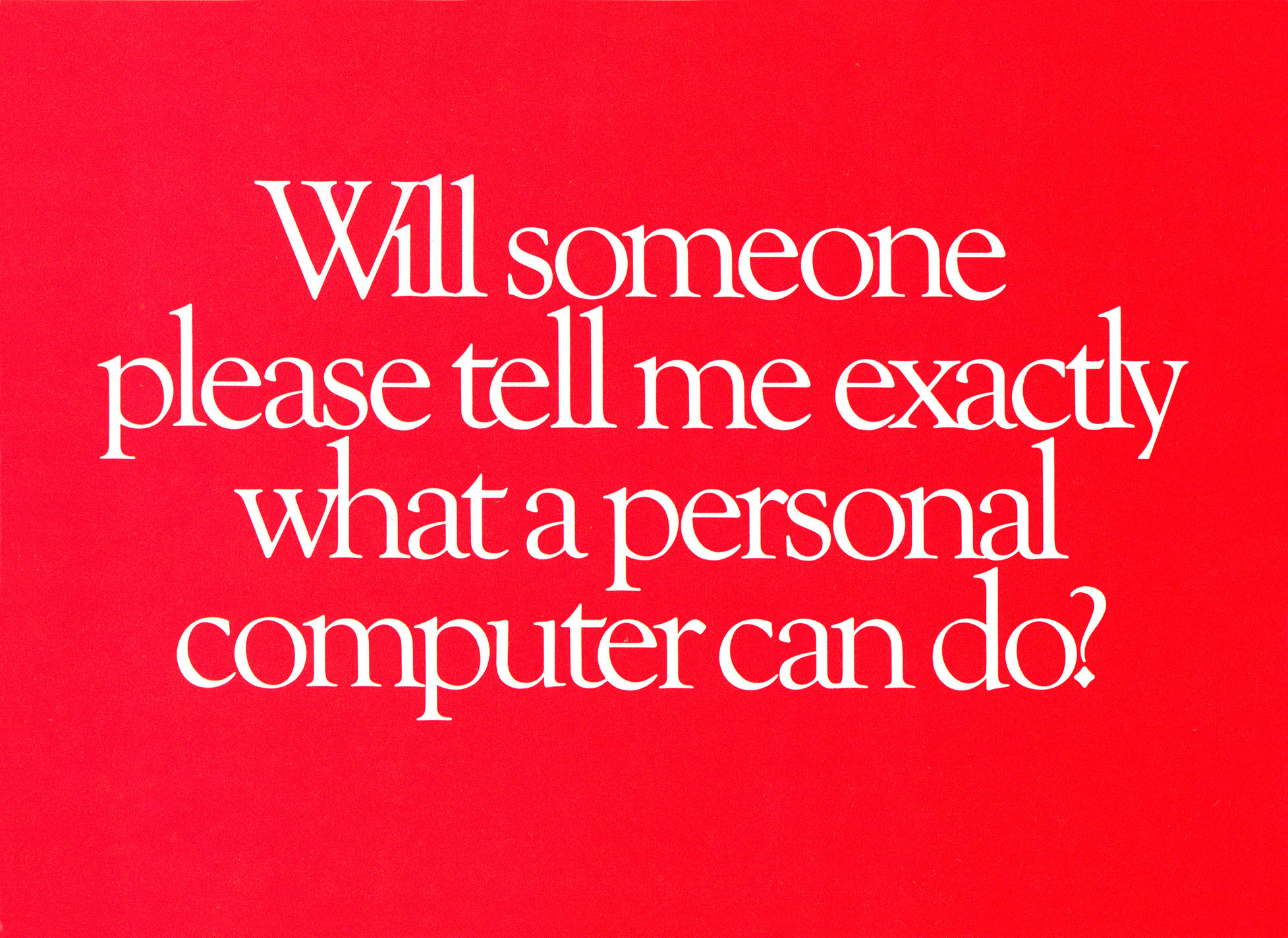
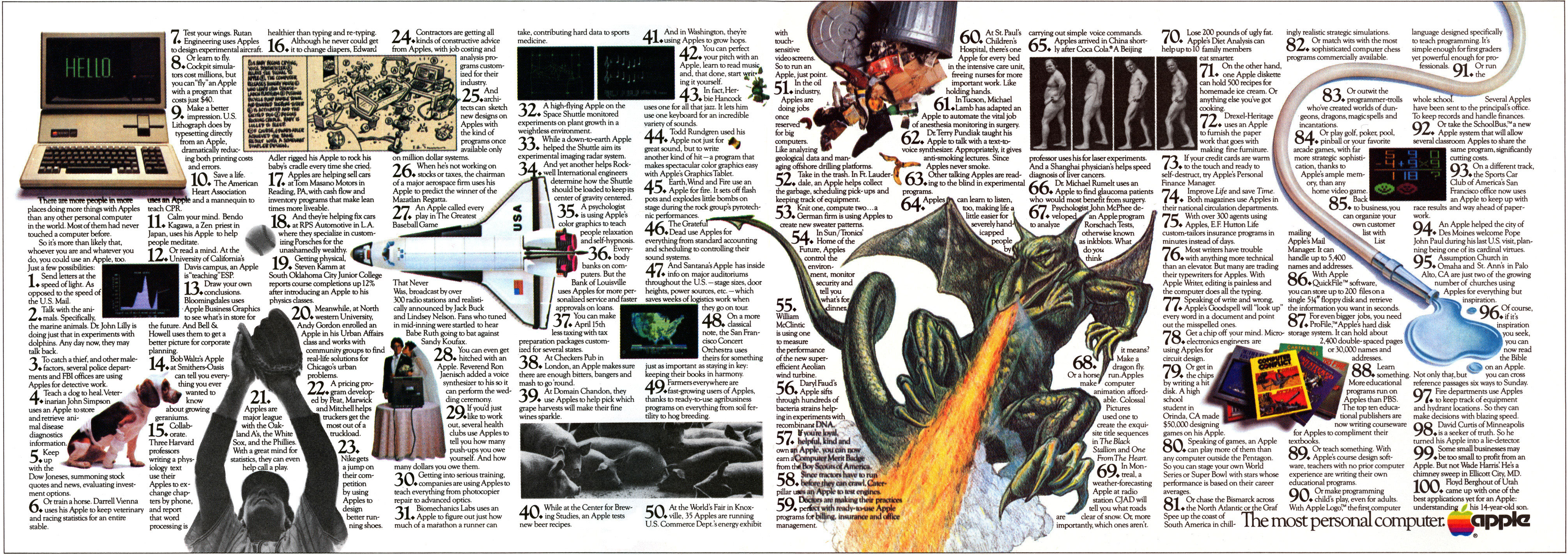
It’s right around this point in the post that I can hear the skeptics asking themselves (reasonably), “But what can the Looking Glass do right now”? It’s a question that comes up a lot in the area of new human-computer interfaces, one of my favorite Foundry Group investment themes particularly because it lives on the edge of the comfort zone. The same question famously came up repeatedly for the personal computer back in 1983, answered by this Apple ad.
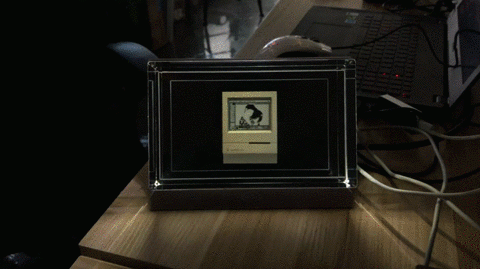
Rather than waiting for a killer app on the horizon, the crew at Looking Glass Factory are taking a page from the early-Apple playbook and answering this challenge with a daily flow of new holographic applications. They’re aiming to get to 100 practical (and in some cases not practical but joyful) things a 3D creator can do with their Looking Glass by the time most of the units ship in December. Here are just a few that have come out over the past few weeks:
WYSIWYG preview of 3D models before 3D printing.
Check out the field of view on this Hologram Player by https://t.co/c06Fr6V9rh !
Will wee evaluate 3D models this way before #3dprinting them?
The Klein Bottle – https://t.co/2K51AfTDQc | #MathArt #TheLookingGlass #Hologram pic.twitter.com/tKLuxzmqFR
— Dizingof (@dizingof) July 14, 2018
Exporting 3D scenes directly from Autodesk’s Maya – and soon supporting a live viewport direct from Maya into a Looking Glass.
New exporter for rendered scenes from Maya to the Looking Glass is fully operational! @AdskMaya @autodesk #ImpossibleThings More here! https://t.co/539XGUR48r. Psst, we’re at #SIGGRAPH2018 Booth #645 if you want to see the Looking Glass IRL! pic.twitter.com/JP343LlrIS
— Looking Glass Factory (@LKGGlass) August 14, 2018
Ramping up other integrations for other 3D creation programs like Blender.
I’m such a #b3d nerd that I have Suzanne on my desk inside a default cube made from glass. Just kidding, it’s a hologram… pic.twitter.com/C8HnOgKe9Q
— Gottfried Hofmann (@BlenderDiplom) July 27, 2018
Voxatron in the Looking Glass: this is a voxel-based engine that was developed by an indie game developer Joseph White in Tokyo. What’s remarkable about this is that Joseph started to develop Voxatron back in 2004 on the belief that one day a holographic display would exist to house it. I really like how in this example a tiny bit of code generates a holographic app in a Looking Glass.
This year, #voxatron will emerge as a fully formed fantasy console AND support a real holographic display: the Looking Glass by @LKGGlass. Here’s a tiny demo cart with src in reply!
☆☆ Order one now via KS, and @ $750k every display comes with Voxatron!: https://t.co/xuUxpaW8dg pic.twitter.com/ZYsMwNyDda— zep @ lexaloffle (@lexaloffle) August 9, 2018
Display of 3D architectural models.
Our good friends at @occipital sent us one of their Canvas scans taken by one of our favorite tools – yup, the @structure! – and we were able to bring that model immediately into a Looking Glass. That is one good-lookin’ space, if we do say so ourselves https://t.co/PuFTNkk7RC 🙃 pic.twitter.com/zZN6nLoQwF
— Looking Glass Factory (@LKGGlass) July 24, 2018
Photogrammetry drone scans of a terrain.
Our friends at @3DRobotics just sent over this drone scan and it looks INCREDIBLE in the Large Looking Glass 😲 Thanks @chr1sa! Large Looking Glasses can be found here: https://t.co/ZW3jpZaBCb pic.twitter.com/ZAZTXRKlgW
— Looking Glass Factory (@LKGGlass) July 26, 2018
And this completely impractical but joyous sloth captured with an iPhone X.
Fun fact: sloths sleep for about 15-18 hours a day, but this sloth is ready to 🎉🥳 PARTY 🥳🎉 iPhone X front-facing camera + the Looking Glass = Sloth parties all day. #ARKit #ImpossibleThings https://t.co/ENWwu8DM22 pic.twitter.com/AGTUQxgSbC
— Looking Glass Factory (@LKGGlass) August 18, 2018
I have a feeling this is just the beginning and I believe this team and the community of 3D creators coalescing around the Looking Glass are going to blow past 100 holographic apps and integrations very quickly.
To see for yourself, head over to the Looking Glass Kickstarter launch. The Standard Looking Glass is normally $600, but you can pick one up for $450 if you grab one of the last units in the next 48 hours.
And as the Looking Glass founders Shawn and Alex say, thanks^3.

On August 13th, I’m giving a talk as part of the Aspen Entrepreneur Showcase. I’m doing an AMA moderated by Chris Klug on:
- Entrepreneurship & Innovation in Rural Communities
- Angel & Venture Capital Investing
- The GiveFirst Ethos and its Impact on Startups
- Forming Great Boards of Directors
- Techstars Accelerator Going International
- Mental Health and Depression
- Philanthropic Giving
- Trends for 2019
And, since it’s an AMA, that means people who show up can ask me whatever they want.
We’ve been soaking (and investing) in the world of 3D printing since our investment in MakerBot in 2011. Since then, we’ve made three other investments in the world of 3D printing – Formlabs, Glowforge, and Looking Glass. While Looking Glass is a holographic display and is the inverse of a 3D printer, you’ll see how it fits into this in a moment.
While I continue to be impressed by Desktop Metal, the incredible press that they get, and am a big fan of the writing of Jason Pontin, I think Jason’s story in Wired – 3-D Printing Is The Future of Factories (For Real This Time) – misses several key points that take the idea that 3D printing is the future in a different direction.
I’ve decided that 3D printing is the REPL for Hardware. Dan Shapiro, the CEO of Glowforge, coined this and he’s completely nailed it. If you don’t know what a REPL is, it’s a programming concept called the Read-eval-print loop. Following is an example of a Python REPL running in a browser.

In the middle window is the Python code for a simple factorial. You hit the “run” button and the REPL reads the Python code, evaluates it, and prints the answer (120) in the right window. Hang on to that idea – Read, Evaluate, Print – we’ll be back to it later.
My first thoughts around 3D printing started at the beginning of 2010, when I read Chris Anderson’s Wired essay In The Next Industrial Revolution, Atoms Are The New Bits. His 2012 book Makers: The New Industrial Revolution helped me understand this better.
At first, I was obsessed with distributed 3D printing. On the desktop. For professionals. Each of MakerBot, Formlabs, and Glowforge took expensive industrial products that cost $50,000 to $500,000 and put them on a desktop for $2,000 to $5,000. The metaphor we used for this was that of the evolution of the laser printer market. If that’s elusive to you, the path from mainframe to PC works also.
We started with our investment in MakerBot, which used a technology called FDM (fused deposition modeling), which is a cousin of FFF (fused filament fabrication). This is a fancy phrase for “heating up plastic, extruding it, and building a 3D thing with the heated plastic”. It was magical, but limited on many dimensions based on the constraints of the materials and the process. As a result, MakerBot (and FDM in general) is primarily a hobbyist and DIY product.
FDM is additive manufacturing. So, when Glowforge came along, we immediately recognized it as the analogous subtractive manufacturing technology. Glowforge is a laser cutter (basically the addition of a laser to a CNC machine). You shine a laser at a material – any material – over and over again to subtract from the material to make your 3D print. As magical as MakerBot was, what Glowforge could do was mind-bending and took 3D printing to an entirely new dimension for me. You could work with paper, granite, sushi, cardboard, chocolate, wood, and basically any other material. Plus, well, LASERS!
We knew Formlabs from our experience at MakerBot. If you haven’t seen the Netflix documentary Print the Legend and you are interested in this stuff, go watch it. It’s the early story of both MakerBot and Formlabs, has endless cringe-worthy moments in it, stars some of your friends, and shows how incredibly challenging a startup is.
Since MakerBot had been acquired, it cleared the way for us to invest in Formlabs, which we did in 2016. Formlabs first product was based on SLA (stereolithography). In this technology, you shine a laser at a vat of resin and it builds up the 3D print (again – additive manufacturing). The quality and fidelity of the 3D prints are much higher with SLA, there are a wide variety of resins, and, as a result, Formlabs has had great success in the prosumer market. Next year, Formlabs will be shipping the Fuse, an SLS (selective laser sintering) 3D printer, which is another, even more advanced technology, at a desktop price point.
With Formlabs and Glowforge, we now have high-end desktop 3D printers at a price point under $10,000 (or at least 1/10th the price of similar industrial products). They are WiFi connected (just like today’s laser printer), have contemporary software, are integrated with everything 3D software related, and work extremely well.
Let’s go back to REPL. You start with a 3D image, which you can either design, get from the web, or get from Thingiverse or Pinshape, Formlabs and Glowforge printers then provide the REPL – it reads the 3D code, evaluates it, and prints it. On your desktop. Next to you. In high fidelity. Right away. Inexpensively.
So – how does Looking Glass fit into this? It still takes some time for Formlabs and Glowforge to print the 3D object, so the output from the REPL isn’t immediate. What if you could visualize the 3D object, in 3D, as an intermediate step? Voila – a holographic display (also known by a variety of other names like lightfield or volumetric display.) Looking Glass is 3D visualization on the desktop, which makes the desktop 3D experience for the professional even more powerful.
In 1984, HP shipped their first HP Laserjet. a 300-dpi, 8 ppm printer that sold for $3,495. A decade later, HP shipped its 10-millionth LaserJet printer. By the end of 2000, they had shipped 50 million of them. Over the weekend, I installed an HP LaserJet Pro M277dw Wireless All-in-One Color Printer, a 600-dpi, 19 ppm WiFi connected color printer / scanner / fax that sells $484.
When someone asks me what they can do with a 3D printer, I wish I could shove them into my time travel machine and send them back to early 1985 to ponder the question “Why do I need a laser printer on my desktop – I’ve already got an Epson MX-80.”
If you make anything in 3D, you now can have a 3D REPL on your desk.
Amy Batchelor and I have been married for 25 years today. Here’s what we looked like a long time ago on a vacation together in Cabo.

R.E.M. and Dilbert together kind of says it all.
Here’s another picture of us in our apartment at 15 Sleeper Street in Boston on Amy’s 25th birthday. Amy remembers that I took her out that night to Biba for dinner.

That keyboard is the one that almost burned down an entire fraternity building on 351 Mass Ave one night. But that’s another story. I loved Amy’s permed hair – maybe that look will come back in fashion some day.
Amy and I are in Dresden on our way to Berlin with my parents right now. They just celebrated their 55th anniversary, which is a remarkable achievement. I hope to have at least another 30 years with Amy.
Happy anniversary my beloved.
We have just hours. The FCC is about to vote to end net neutrality—breaking the fundamental principle of the open Internet—and only an avalanche of calls to Congress can stop it. So we decided to help “Break the Internet” on our sites. You can also support on Twitter, Tumblr, Youtube or in whatever wild creative way you can to get your audience to contact Congress. That’s how we win. Are you in?
More info here.